
Julia Blackwell : Fascia & Mobility vs Flexibility
CLICK FOR AUDIO OF PODCAST
In fact, welcome to Trulyfit, the online fitness marketplace connecting pros and clients through unique fitness business software.
Steve Washuta: Interestingly, welcome to the Trulyfit podcast. Here we interview experts in fitness and health to expand our wisdom and wealth. I’m your host, Steve Washuta, co-founder of Trulyfit and author of Fitness Business 101.
What This Episode Covers
Steve Washuta: Notably, on today’s episode, I have Julia Blackwell, who you can find on Instagram at Movement by Julia. Julia has been on the podcast before, when we discussed pain and fascia. She’s a fascia expert, and we revisit some of that ground here for anyone who missed it. I do a “who, what, where, when, how” breakdown. Who needs fascia work? What’s the goal when we’re rolling out? Where on the body matters, and how do we know it was effective? We also cover common hip issues that fascia plays a role in. And for anyone considering fascia work as a career, we get into how to actually get started. That includes whether to fold it into an existing practice or do it on its own. Julia has been doing this for 13-plus years, and it was a great conversation.
As it turns out, i want to remind listeners about our first episode together, “Pain and Fascia.” It’s still available to go back and watch or listen to. That one was a deeper dive, more of a 400-level course. This episode is closer to a 101 before we get into specific hip-complex issues. Be sure to follow Julia at Movement by Julia on Instagram. With no further ado, here’s Julia and me.
Steve Washuta: To that point, julia, welcome back to the Truly Fit podcast for the second time. The first episode was fantastic for those who didn’t hear it. Why don’t you give a brief background and bio of who you are? Tell us your credentials, and what you do day to day in the health industry.
Julia Blackwell’s Bio and Fascia Background
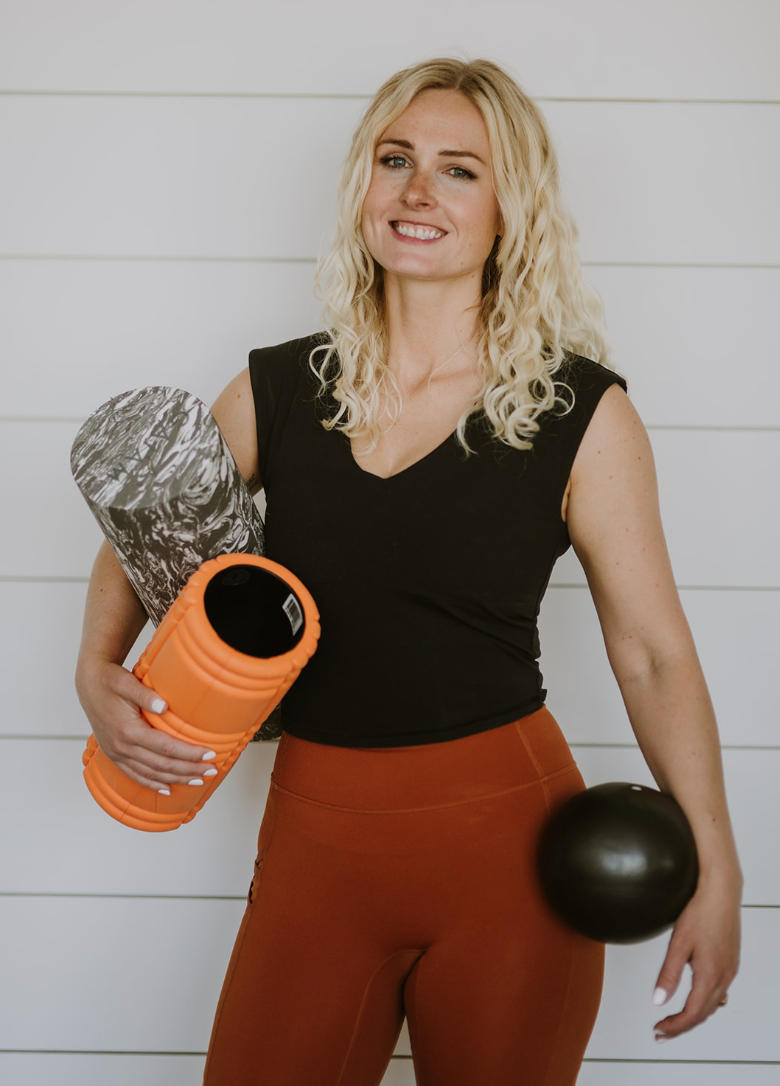
Julia Blackwell: Overall, thanks, Steve. I’m so excited to be back. I’m a fascia release expert, educator, and practitioner. I’ve had an in-person practice in Golden, Colorado for the last 13 years. I help with pain as well as issues with mobility and performance recovery. That also includes relieving stress and trauma from the body through strategic fascia release work. I work both in person and virtually. I help a lot of people through virtual courses and virtual sessions these days. So many of us have needed that option since 2020. So it’s a wide range: I work with anyone from an everyday mover to professional athletes. It’s been a really fun and exciting decade-plus.
Steve Washuta: For anyone who thinks that first episode was just an intro, it wasn’t. You could actually go back and listen after this one, because we did a real deep dive into all things fascia. It’s more like a fascia 301, where we got a bit more sciencey. I don’t know if we’ll get there today, since we want to focus on other things. So we’ll probably stay more at a one-on-one level.
Julia’s Practice Today: New Certifications and a Growing Team
Steve Washuta: For context, let’s start with you. Does it feel like your practice has changed since we last spoke? Do you do anything outside of fascia work, or is that the focus right now?
Julia Blackwell: In the last six months I’ve hired a new practitioner to join my practice, which has been exciting. I’d been training her since 2020, and it’s allowed me to step away from the hands-on side a bit. I was doing so many sessions, and I love it, but I’m stepping more into an educator role now.
That said, i have two certifications. One is more entry-level, covering how to understand fascia and pain patterns, and assess a client’s alignment and movement. It also covers how to address that fascia using recovery tools like foam rollers, lacrosse balls, or soft Pilates balls. I also have a bodywork mastery program that teaches the actual physical bodywork side of this work. So I’ve been stepping much more into the teacher role, and it’s been really fun.
The Physical Toll of Hands-On Fascia Work
Steve Washuta: Meanwhile, one would think you’d need to step back even quicker than someone like me. As a personal trainer, I can get through a whole session without touching a client. With you there’s so much that’s hands-on.
In particular, you have to worry about arthritis and things like that down the road. It can be intensive, almost like massage-therapy work. Eventually you have to dial back the physical part of the job and move into more of the educational realm.
Julia Blackwell: Ultimately, sure. I’ve also just seen so many incredible results over the years, with clients who’ve had wild transformations. I got tired of keeping that to myself. I can only work so many hours physically. My impact is smaller if it’s just me in my office every day. So I’m getting that same excited feeling I used to get when I helped someone resolve their pain. Except now it happens when one of my practitioners tells me they fixed someone’s plantar fasciitis. It’s really exciting to get more impact and bring this work to a wider range of people.
Why Julia Blackwell Moved Into Teaching
Steve Washuta: In fact, that intrinsic motivation is going to drive you more than money or simply expanding. Wanting to help more people is really how you end up expanding in a more meaningful way.
Julia Blackwell: If you go back and listen to our first episode, I talk more in depth about my own story. I also talk about how this work helped me in a way nothing else could, given the nerve damage in my arm. I’m also an active person, and pain is part of life. Sometimes you get knee pain, or wake up with a crick in your neck. Being able to resolve these things on your own once you know how is something that gets me excited. I want everyone to know it’s possible for them too.
What Is Fascia, Exactly?
Steve Washuta: Interestingly, let’s quickly go over fascia itself so people have an understanding. I’d like to do it from two angles. First, what is fascia if you’re talking to a 12-year-old, or someone with no background on the body at all? Second, what is fascia in a way that might tell a personal trainer something they don’t already know?
Julia Blackwell: Notably, scientifically speaking, fascia is the biological fabric that weaves through every single cell we have. It organizes all of the water and material in our body. For a 12-year-old, think of it like plastic wrap around every single thing. Every muscle fibril, every muscle fiber, every muscle, tendon, ligament, joint, organ, bone, and nerve is wrapped in a three-dimensional plastic-wrap suit on the inside.
Because fascia wraps around everything, it influences the position and function of everything. It’s what gives us our shape and structure, and what lets our muscles and joints glide. It’s also what gives us our springiness, and how we absorb shock and stay resilient. That’s also how hydration and nutrients get down to the cellular level. So essentially, it’s plastic wrap with a hydration and irrigation system built in. It’s a secret system doing many different things behind the scenes. It really influences how our body moves and functions as a whole.
Fascia vs. Connective Tissue and Myofascial
Steve Washuta: As it turns out, i’ll add one thing to that. My first thought is always to put myself in the general public’s mindset. They’d ask, “Well, Julia, if it’s all that, how come I’ve never heard of it?” You have heard of it, but they call it connective tissue.
Julia Blackwell: To that point, yes, and they also call it myofascial, which you can call it. But “myo” scientifically means muscle, so myofascial really only refers to fascia around the muscle. Fascia is an entire system: it wraps around organs, it wraps around bones. I like to think of it as one whole system, much more than just the muscles. I’ve also heard people describe it like a sausage casing around the outside of a muscle. So it’s important to understand the layer-upon-layer system it actually is, which we’ll get into more as we go.
Fascia’s Role in Flexibility, Mobility, and Stability
Steve Washuta: Overall, what role does fascia play in flexibility and mobility? Does it factor into both, and what’s the difference between the two in your mind?
Julia Blackwell: For context, good question. Let’s start with flexibility. Most of us think of flexibility as stretching: lengthening a muscle fiber in one plane of motion. It’s usually focused on just one muscle or muscle group at a time. I think of that as an older model of thinking, and honestly I care fairly little about flexibility. I’ve seen plenty of gymnasts and others with great flexibility in some areas and a lot of struggles in others. What I care about more is mobility.
That said, mobility, to me, means active movement: full range of motion through a joint. Most importantly, it means motion in a three-dimensional way. I care much more about our muscles’ and joints’ ability to move three-dimensionally across multiple planes of motion. Hand in hand with mobility is stability, our ability to control the mobility we have against the impact of gravity. All of the force traveling through our body travels through our fascial system. We have ten times as many proprioceptors in our fascia as we do in our muscles. So a lot of how we understand where and how to move our body comes from our fascial system as well. The same goes for how we control it.
Who Needs Fascia Work?
Steve Washuta: Meanwhile, who needs fascial work? That’s the next question the general population asks: how do I know when I need it? I want to run through what I call the who, what, where, when, and how of fascia work. Let’s start with who.
Julia Blackwell: In particular, truly, the vast majority of people do. I’ve worked on kids as young as eight, and I have a current client who’s 81. Everyone in between usually needs this work. That’s true if they’re experiencing pain, stiffness, or injury, or if something bothers them every time they work out. Those consistent nagging issues, slow recovery times, and waking up stiff in the morning are all signs. Really, anything where your body isn’t functioning optimally means you could use some fascia work.
The Goal of Fascia Work: The Wet Sponge Analogy
Steve Washuta: Now onto the what. What’s the goal?
Julia Blackwell: Ultimately, ideally, it’s to rehydrate and re-pattern our fascia so we can restore our movement capabilities. Here’s another analogy: fascia is a bit like a wet sponge encasing everything in our body. The more we sit, and the more we repeat the same movement patterns, the more injuries we sustain. We start to get a version of a dried-out sponge in our body.
If you try to twist and bend a dry sponge, it’s brittle. It doesn’t move easily, and it’s more likely to snap, that’s the analogy for injury. What we want is the most hydrated, wet-sponge version. That’s what lets us move any way we want, feel fluid in whatever we do, and have no real limitations.
Where to Focus: The Body’s Most Common Tight Spots
Steve Washuta: In fact, the next one is where. Where on the body is important, and I don’t want to lead the witness too much. But I think you’d agree that a lot of the time, where the pain is isn’t where the problem is. How do we make that distinction?
Julia Blackwell: Interestingly, ideally we want to work everywhere in our fascia, because it’s all one connected system. That goes from bigger muscle groups like the quads and core all the way down between our metacarpals. But over the years I’ve found some spots tend to be tighter on most people. The quads, adductors, core fascia, lats, and pecs are probably the top areas most people need work on. That’s because we sit so much, breathe poorly due to stress, or slouch. We also don’t do a lot of overhead arm movement.
Notably, those are certainly the top areas contributing to a lot of different aches and pains. But you’re right that where you feel pain is almost never the problem. So there’s some discovery and learning involved in figuring out what’s really necessary for your specific pain.
When to Do Fascia Work: Before, After, or on Rest Days
Steve Washuta: When is next. Do we do this pre-workout, intra-workout, post-workout, on rest days, or all of the above?
Julia Blackwell: As it turns out, it depends on your intention. If you’re looking to warm up your muscles or improve mobility a little, it’s great to do beforehand. That helps you have a more successful workout. Say you’re about to do overhead squats and need the best mobility you can get. If you’re looking to improve recovery time or reduce soreness, do it after your workout. The same goes if you want to generally improve your sports performance over time.
But if you’re experiencing a lot of pain, you don’t need to wait for a workout. On a rest day, anytime you start to feel that pain coming on, I’d tackle it sooner rather than later.
How to Know It’s Working: Compression, Cross-Fibering, and Movement
Steve Washuta: To that point, i thought maybe what or where was the hardest question. But maybe this is: how do I know it was effective? Is it just subjective, “well, there was pain and now there isn’t,” or is there some kind of objective measure?
Julia Blackwell: Overall, there are two parts to the how. The first is that we have to address fascia in a way that combines compression, cross-fibering, and active movement. Instead of simply rolling up and down on a roller or lying on a massage ball for ten minutes, we need to compress an area of fascia. Then we actively move it. The cross-fibering usually happens through that active movement. It’s a crucial part of rehydrating and re-patterning fascia, probably different from most of what you’ve done before.
As for how you know it was effective, there’s usually a feeling of warmth right after. Occasionally you’ll feel a cool rush instead. That’s a great sign blood flow is reaching the area and hydration is returning. I usually feel a bit of gentle tingling or lightness too. That’s one of the most common things I hear from others. You may feel an immediate decrease in pain or increase in mobility. The more consistent you are, the quicker the results. Long term, you should feel more loose, fluid, and pain-free, with better performance overall.
What Active Movement Looks Like in Practice
Steve Washuta: For context, that was great information. Can you elaborate on what you mean by active movement without using the roller itself as the moving part? I know you’re saying the roller stays in one place and your body moves around it, almost like a fulcrum. But give us a clearer picture.
Julia Blackwell: That said, we talked about stretching, lengthening a muscle in one plane of motion. On its own, that does very little. The idea is: can we press a massage ball or roller into a certain area? Say, for example, the calf. Say I press a ball into my calf and start flexing, pointing, and circling from my ankle. Now I’m moving different parts of that muscle. It moves in a more three-dimensional way, through different planes of motion.
Meanwhile, that’s the key, and it doesn’t need to involve your whole body. Though there are fun, dynamic ways to incorporate bigger movements too. Sometimes it’s as simple as pressing a lacrosse ball into your pec and reaching your arm overhead. Add some internal and external rotation. That three-dimensional movement is really what starts to remold and restructure the fascia.
Cross-Fibering vs. Just Rolling Back and Forth
Steve Washuta: In particular, you don’t see that enough. Anecdotally, looking around the gym, people use the roller the way you’d assume, just rolling on it. Instead, say, you could put it across your back perpendicular to open and close your shoulder blades. Or put your hands behind your head and get into the smaller muscles around the scapula. Put pressure there and move around, rather than just rolling back and forth, which seems more superficial.
Julia Blackwell: Right, that only gets the first few layers of fascia, moving roughly with the grain of the fibers. When we incorporate shearing movements, moving perpendicular to the way our muscle fibers run, it activates a cell in our fascia. That cell is called a fasciacyte. That’s the kickstarter for producing hyaluronic acid in the body, which is essentially full-body grease for both joints and muscles. Without cross-fibering, we’re not affecting those deeper layers, and we’re not maximizing the hydration we can get to that spot.
Can a Muscle Be Both Tight and Weak?
Steve Washuta: Ultimately, personal trainers, and the general population, often assume that if a muscle is very tight, it must be overworked. That’s something I deal with a lot in my industry. They can’t quite put together the concept that something can be both weak and tight. Can you explain why that’s actually the more common case, especially for the general population? And how does the work you do address it?
Julia Blackwell: In fact, there is a possibility something can be both tight and strong. That’s usually related to workout volume or repeating the same movement often. But there are really two different versions of this. Tight-weak is very common: the body sends its resources to the areas you’re actually using. So say you’re not very active, or you keep using the same specific muscles. Everything else then stops getting the same resources. Fascia starts to shrink a little and stick to itself.
Interestingly, think back to the plastic-wrap analogy: it starts adhering to itself and pushing hydration out. There’s less blood flow, and the brain sends less innervation and less capacity to fire nerves. The muscle loses its ability to expand and contract at full capacity. As it shrinks down with everything inside it, that muscle becomes weak, but it’s also very tight.
The Hamstring Example: Why Stretching Alone Doesn’t Fix Tightness
Julia Blackwell: Notably, there’s also a concept of being tight in a lengthened position. That’s a little different from being weak, though it can absolutely be weak too. I see this a lot with hamstrings: people say their hamstrings are so tight, and they stretch and crank on them. But it doesn’t resolve. The issue is usually tension on the opposite side, in the quads and hip flexors.
As it turns out, most of us do mostly quad-dominant activities unless we’re very intentional about it. When the fascia in the quads and hip flexors gets tense, it tends to pull the pelvis forward. That creates an anterior tilt. The hamstrings, attached to the back of the pelvis, get lengthened by that tilt. They lock down to keep the pelvis from toppling forward with the rest of the spine. Your hamstrings won’t have any real opportunity to let go until the problem on the opposite side is addressed.
To that point, this is also true in the upper body. Most people with back-of-the-neck or upper-back pain actually have an issue coming from the front. Tension through the pecs, scalenes, and front of the neck contributes to that lengthening and pain in the back. Those muscles might feel tight or stiff, but they’re holding on to prevent a worse misalignment or spinal compromise. It’s hard for a muscle to get stronger if it can’t fully let go and also contract.
Julia Blackwell on Anterior Pelvic Tilt
Steve Washuta: Overall, that’s a good segue into common hip issues, since you mentioned anterior pelvic tilt. How do you deal with that from a fascial perspective? A lot of the general population has this because of sitting all day. Things get weak, things get lengthened that shouldn’t be, and things get tight. I see more people with anterior pelvic tilt than posterior tilt, and few with a truly neutral pelvis. It also takes people a while to even understand the difference. If I try to teach someone to actively shift into anterior and posterior pelvic tilt, most people can’t do it right away. It takes practice. How do you go about working with people on this? And do you see it as a primary issue, or usually a secondary one?
Julia Blackwell: For context, a little bit of anterior or posterior tilt doesn’t concern me much on its own. But it’s rare for a tilt to present alone, since everything in the body is connected. When there’s an excessive anterior tilt, that big arch in the low back, you’ll usually see it show up alongside other things. Outwardly rotated “duck feet,” some external rotation in the femur, and a forward head tend to show up together. Excessive posterior tilt usually comes with kyphosis, that rounding forward of the upper back and shoulders. It often comes with a bend or hyperextension in the knee too. So it’s more a clue to look at the bigger picture.
Pelvic Rotation: A Bigger Concern Than Tilt
Julia Blackwell: That said, even more concerning than a tilt is rotation in the pelvis. I actually see that more often than tilt. That means you might be rotated forward and down on one side and shifted up and back on the other. Rotation tends to be more problematic because your spine is no longer on a stable surface. It can cause low back pain, sciatica, SI pain, knee pain, or plantar fasciitis. That’s a whole list of things that can happen when the body is functioning at that strange rotation.
The Adductors’ Hidden Role in Pelvic Alignment
Steve Washuta: Meanwhile, not to mention, sorry to interrupt: a lot of times you get a functional leg-length discrepancy. That’s because the pelvis is turned. Then muscles on one side get used more than the other. That’s because the legs are off, because the hips are twisted.
Julia Blackwell: Right, and then you end up with arthritis on one knee, or an issue on one side of the body. You tell yourself it’s just your “bad leg,” all these justifications. But if your hips were in a neutral position, the wear and tear would be even on both sides. That one-sided pain likely wouldn’t be happening. The real question is why the pain is only on one side and not the other. The answer is always in how your alignment looks, and that’s a huge indicator of what’s happening in the fascia.
If you know you have a big tilt in your pelvis, here’s one little-known fact: the adductors, the inner thighs, are the biggest indicators of pelvic tilt, more than the hamstrings and quads. That’s especially true high up toward the tendon. I know we tend to overlook them. But that would be my number one spot to start working on your own. Get as high up into the adductor as you can.
How to Release Your Adductors at Home
Steve Washuta: In particular, let’s give some tangible ways to do that. What’s your recommendation if you’re not working with a practitioner and you’re at home with a foam roller? How do I work on my adductors?
Julia Blackwell: Ultimately, you can use a foam roller. But if you have access to a basketball, that might be even better. Lie on the floor in something like a plank position, lift one leg, and put your high inner thigh on top of the basketball. Use a foam roller instead if that’s what you have. I sometimes need more leverage, something higher off the ground to reach the high spot of the adductor. Then I place my weight down on it.
Steve Washuta: In fact, i’ll give another analogy: it’s like the dog peeing on the fire hydrant.
Julia Blackwell: Interestingly, there you go, that’s it. Get as close as you can to about a 90-degree angle at the hip and knee. From there, straighten and bend your knee a few times slowly. If you can, bend it back to 90 degrees and lift and lower your heel a few times. That’s where the cross-fibering action comes in. Do that four to ten times, come off that spot, and walk it out. You can do two or three spots on each side depending on how tight it feels. You could do this with a foam roller or a medicine ball, whatever you have. Just make sure there’s a good amount of compression happening. It can’t be a pillow.
Why Adductors Atrophy and What to Do About It
Steve Washuta: Notably, going back to something you said before, which ties together nicely: the adductors matter so much here. As you said, when muscles aren’t being worked, they atrophy. Because they’re smaller muscles, they don’t get used the same way in traditional sagittal-plane exercises. When you’re doing heavy squats, deadlifts, or even lunges, the adductors are at best a tertiary muscle. They’re not firing because the bigger muscles take over.
So unless you’re doing specific exercises to fire those muscles, they atrophy. The fascia, according to you, essentially decides it doesn’t need that area. So it crinkles up, pulls water out, and the proprioception there gets thrown off. That’s why we need to focus on smaller muscles and make sure we’re actually firing them. Even if you do the fascial work but never use your adductors, you’ll have to keep doing it. That work becomes indefinite.
Julia Blackwell: As it turns out, perfectly said. I’d only add that so many of us sit with our legs crossed. Even in a normal sitting position, our femurs tend to rotate inward a bit. So the shortening of the adductors from not working them during a workout is one factor. Combined with sitting in a shortened position, it’s a recipe for tension to accumulate there.
From Personal Training to Fascia Release: Julia Blackwell’s Career Path
Steve Washuta: To that point, let’s move into some of the business side for people in our industry. Say someone listening has been a personal trainer. They see that fascia release is really helping their clients, and want to go this route. What advice would you give them? Is there a course they should take? Should they fuse it with an existing business first, since it’s hard to build a client base doing only this?
Julia Blackwell: Overall, good question. I’ll be a little biased here, since I have a fascia release specialist certification. I feel it has the newest research and the most holistic view of how to assess pain and posture and get fascia to its best possible state. But I actually started as a personal trainer around ages 22 to 26, mainly focused on corrective exercise. I’ve always been in the world of rehab. Being born with nerve damage put me on that track from a young age. I was already getting clients coming to me with pain and limitations.
As I started learning fascia work, it turned out to be the perfect combination. I’d train someone for 45 minutes and do fascia release for the last 15. That became 30 and 30, and then some people just wanted to come for fascia. I was getting much better results with it than with corrective exercise alone. So I think the combination is powerful. Ultimately I fell out of love with training and completely in love with fascia instead. Keeping both together honestly would have been a great career path too, since not many people are doing that combination well.
Taking Fascia Work Virtual
Julia Blackwell: For context, it’s a big deal to have this extra skill set. It’s also enabled me, with the recovery-tool work, to take on virtual clients. That’s something I didn’t know I could do until 2020 forced all of us to ask how we could still help people from afar. I’m able to see what someone’s alignment looks like and talk them through the recovery work on their own. So it’s also a way to expand how many clients you can work with.
Virtual vs. In-Person: What Gets Lost Over Zoom
Steve Washuta: That said, i talk about this a lot in personal training too: the difference between virtual and in-person work. It’s not 100% the same. If you and I are together in a room, you can actually palpate and put your hands on me. You’re always going to have a bit more information that way. How do you navigate that, and what’s important to keep in mind when doing virtual work in the fascial space?
Julia Blackwell: Meanwhile, i have people submit photos of their standing posture, since it’s very difficult to see alignment on Zoom. I need pictures taken a specific way from all angles to really understand what’s going on. Ultimately it’s not the same. I’d much rather see someone in person. I can combine recovery work with actual bodywork, adding real weight, sometimes my full body weight, on an area of fascia. The change you can create in a small amount of time is unbeatable that way.
Still, I’ve been able to work with people all over the world, talking them through the right way to do the recovery techniques on their own. It just takes a bit longer. But the results are similar, because we’re using the same principle: compressing with active movement. We go to the right places in their fascial system that are likely causing the pain. It just takes longer without that intense in-person compression, but it still works.
Why Hands-On Work Still Has an Edge in a Digital Fitness World
Steve Washuta: In particular, here’s something I’ve been thinking about, and I’d like your take. When everybody’s zigging, sometimes it’s good to zag. Yes, going online is great, and everyone’s online now. You can’t not have a foot there, or you’re missing out on a piece of the pie. That matters for lifestyle too, since we can’t work unlimited hours. AI is now able to design a better workout than I can, at least maybe within a few years.
But I think it’s important to keep that hands-on, personal touch in our industry. What you do is even more personal than personal training in some ways. There’s a real connection when you’re helping people physically. So my general take is: keep your physical practice and the ability to work with people hands-on. That’s really what you can charge a premium for. You’re not going to be able to upcharge for online work, since everybody’s offering that.
Ultimately, what you can do is imagine someone with your skill set who’s also personal training. Give a client two hours: 15 minutes to warm up, a 45-minute workout, a special cool-down, then a fascia release. All of it happens in one session. That’s not offered anywhere else. So while everyone else is running toward purely online, think about what you can do with a hands-on approach. It lets you build a real connection with a client.
Fast Relief Builds Referrals: The Business Case for Fascia Work
Julia Blackwell: In fact, absolutely, and in that same vein, everyone wants to feel a difference in whatever they’re doing. They want it as soon as possible. No one wants to hear from a chiropractor that they need to come three times a week for six months. That’s a long time to wait to fix back pain. Sorry, my dogs are going bananas.
But with this type of work, if you can really understand what you’re feeling in someone’s tissue and how they’re moving or holding their alignment, you can provide a quick moment of relief. That’s how you get the most raving fans. I’ve seen that happen more often than not. I don’t want this to sound like a brag. But I haven’t had to market my practice in about six or seven years. That’s because I help people understand their own body and get to the real root cause of their pain patterns.
Interestingly, that builds an incredible kind of word of mouth: they tell their friends. That sets you apart from someone who only has one thing to offer. It also sets you apart from someone who doesn’t really understand why a client has knee pain and just tells them to avoid lunges. You’ll have much better client longevity if you can help eliminate their pain, or at least make it manageable. That extra skill set makes the difference.
Certification, CEUs, and Where to Learn More
Steve Washuta: Notably, is your course connected to any CEUs from other training programs?
Julia Blackwell: As it turns out, not yet, but that’s actually an application I’ll be submitting soon.
Steve Washuta: To that point, we could talk off camera about that. I’ve done it with several of my own courses, and it’s worthwhile and not that difficult. Where do people find your course, and where can they find more about you? That includes people with a course question, since they’re in our industry, or general population members with questions about their own pain.
Julia Blackwell: Overall, the easiest place to go is movementbyjulia.com. That has more information about me and my practice, and it also lists my certification courses. If you need more info, or want to make sure it’s the right fit for your industry or credentials, I’m happy to hop on a call. I’ll make sure it’s going to work out well for you.
Steve Washuta: For context, i’ll put all of those links in the podcast description, along with the link to the last podcast, which has both audio and video. You can watch it if you want an even deeper dive into fascia release. My guest today has been Julia Blackwell. Julia, thank you for joining the Truly Fit podcast.
Julia Blackwell: That said, thank you so much.
Steve Washuta: Meanwhile, thank you for listening to the Truly Fit podcast. As a reminder, if you prefer watching the episodes, you can go to Spotify or YouTube. Please subscribe, rate, and review on your listening platform. Feel free to email us anytime at social@trulyfit.app.
In particular, https://www.movementbyjulia.com/
CLICK FOR AUDIO OF PODCAST
If you want to go deeper into the science of fascia and how it connects to pain, check out this blog: Fascia & Pain: Julia Blackwell.